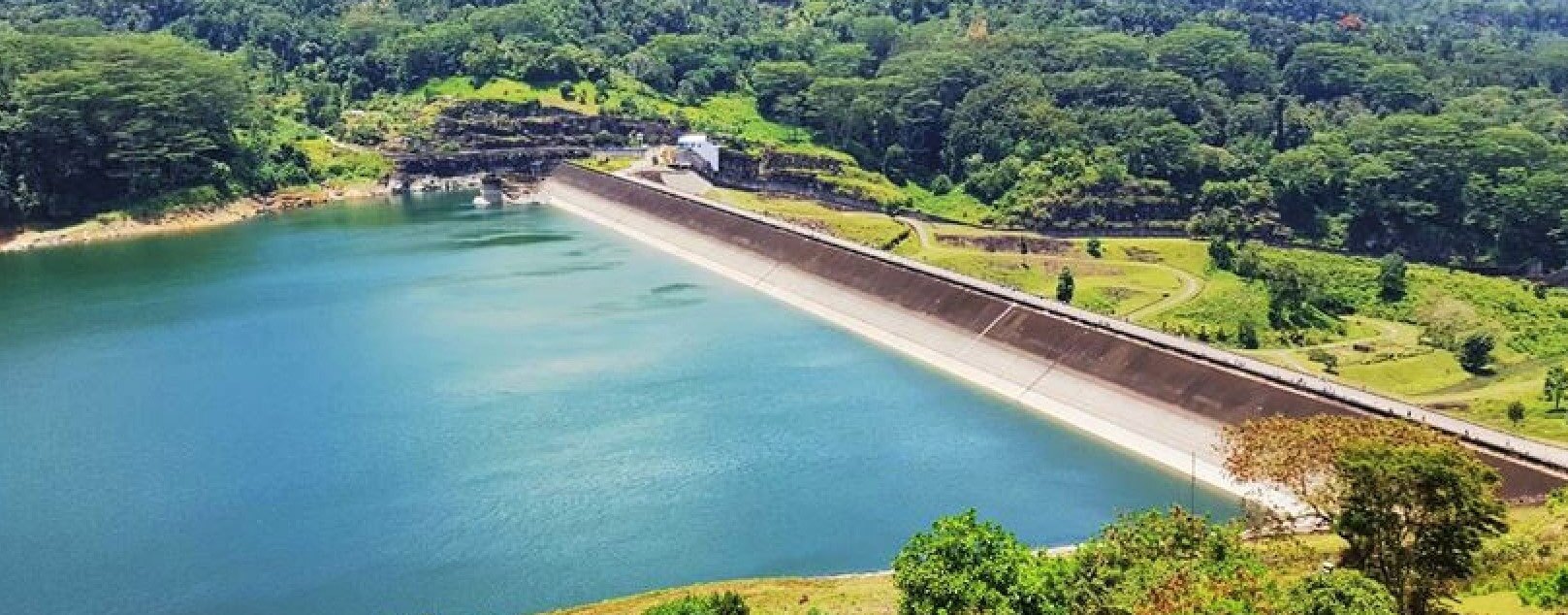
|
Development of
the Mahaweli Ganga has been a centerpiece of Sri Lanka's
development thinking for 35 years. Formal work on the
Mahaweli Ganga Development Program started in 1958 and a
30-year master plan was formulated in 1964-68. The
program expected to provide, and in large
measure has provided, employment in construction, land
for the landless, food, and electric power, together
with an appealing focus for foreign assistance.
The World Bank extended IDA credits for a series
of projects that supported the Mahaweli Authority, which
managed the program. Though the Bank provided relatively
little money (6.2 percent of the total funding for
Mahaweli by 1990) it played an active role in advising
on the size and composition of the Mahaweli program and
in coordinating external assistance.
OED
recently audited the third of the Bank-assisted
projects, which was executed in 1982-92. It finds that
the project was soundly conceived and well, if slowly,
executed, assisting large numbers of poor families. But
environmental aspects were neglected. And economic
returns were much lower than expected, due partly to a
long delay in implementation and partly to a dramatic
fall in the price of rice to producers. The audit draws
lessons.
Introduction
During the 1970s
Sri Lanka's annual growth of agricultural production
fell behind that of population. Real per capita GDP
declined by 1.3 percent a year and open unemployment
increased. The new more market-oriented government
elected in 1977 accelerated the development of the
Mahaweli Ganga Development Program.
Project
goals
To assist the accelerated program, the
Bank-assisted Third Mahaweli Ganga Development Project
was approved in 1981; a credit of $90 million supported
a total project cost of $200 million. This was an
archetypal integrated rural development project, which
started from raw jungle to provide productive
investments and all social infrastructure and services
for a population projected to reach about 180,000. The
project was expected to produce 186,000 additional tons
of paddy, with significant volumes of other crops. Most
importantly, it would provide land to the landless, and
relieve population pressure.
Before development
most of the project area was virtually unpopulated, but
population pressure from the wet zone (southwest and
central highlands) was leading to increased immigration,
with associated shifting cultivation. The project
involved jungle clearing, land leveling, and on-farm
development over a gross area of about 31,000 ha, and
settlement of a projected 18,500 families each with 1 ha
of irrigated land and a 0.2 ha homestead plot, as well
as 5,500 nonfarming families, also with homestead plots.
The project also provided for fuelwood (3,000 ha) and
cashew plantations (2,000 ha). The Mahaweli Authority
provided support services such as extension, marketed
inputs and outputs, and operated and maintained the
irrigation system. It installed roads, urban centers,
and social infrastructure including schools.
Implementation
Implementation took twice
as long as originally planned. The cost of Rs. 8.45
billion ($263 million) was about 30 percent higher, in
real terms, than originally budgeted.
The
proposed project size and phasing were too optimistic,
given the experience with earlier phases of the scheme
and the capacity of the implementing agency. The
schedule at appraisal called for jungle clearing at
around 5,300 ha/year, on-farm development at 5,700
ha/year, and settlement of 5,300 farm families/year. The
implementing agency was already overstretched, and the
project posed new technical and organizational issues.
Many agency staff were newly recruited and were working
with contractors from a recently emancipated private
sector. Civil unrest caused disruptions.
Delays
in providing water to cleared land led to problems with
spontaneous settlement and to jungle regrowth. As
designed, the project gave priority to farmers displaced
from areas flooded by other parts of the Mahaweli
scheme. It did not foresee that these involuntary
resettlers--and also refugees from civil disorder--would
arrive before enough irrigated land was ready for
distribution. Some would-be settlers had to be
accommodated for two years before they could be assigned
land; the World Food Program played a major role in
feeding them.
The relationship between the
borrower and the three cofinancing agencies -- Japan's
Overseas Economic Cooperation Fund, the Kuwait Fund, and
IDA -- was generally satisfactory. Project managers
responded well to advice provided by Bank supervision
missions, which was relevant and realistic. The good
relationships were especially helpful in maintaining
activities through periods of civil unrest in the
project area, and in agreeing the four extensions of the
credit closing date.
Results
The project
achieved close to its targets for physical works,
numbers of beneficiaries, and rice production. It
provided irrigated farms to 16,136 settler families (87
percent of the number estimated at appraisal) at a total
cost of $17,350 per irrigated farm. This gross cost
includes forest clearing, irrigation works, roads,
social infrastructure, supporting towns, and more than
2,000 families who were settled without irrigation. Jobs
were created for 8,000 landless families. Training under
the project upgraded the technical competence of project
staff and farmers.
The project significantly
expanded the land available for paddy production. By
1993, allowing for double cropping, the project was
contributing 122,000 hectares of paddy from about
100,000 ha of new arable land formerly under forest.
Additional rice production is estimated at 145,000 tons,
or 95 percent of the appraisal estimate.
Incomes
were much lower than expected. The project turned out to
be unsatisfactory in economic terms, less because of
poor design, or poor implementation, but because the
terms of trade shifted against rice production.
The present income of farming settler families
is about twice their estimated "without project" income.
This is much lower than the five or sixfold increase
projected at appraisal.
Land sales to settlers
were deferred. Settlers did not receive title to their
land. The project design provided that the cost of land
improvements was to be recovered by sale of the farm and
house plot given to each settler, and that settlers
would receive clear title to their land. But no payments
have been made by settlers and ownership rests with the
government.
Farmers remain dependent on the
government. Most farmers, and especially those in the
most recently settled areas, still depend heavily on
government initiatives and services.
Maintenance
has been inadequately managed and funded. Operation and
maintenance arrangements are deficient and the
irrigation facilities built under the project face
premature deterioration. Though it actively provided
support for farmer organizations, the project had
limited success in transferring management
responsibility to farmers for planning water use and
cooperating to maintain the distribution system.
Water charges were collected from farmers at
first, covering about half the cost of operating and
maintaining the irrigation facilities. But cost recovery
was abandoned as farm incomes turned out to be lower
than expected. Collections fell from 90 percent of the
amounts due in 1985 to 25 percent in 1989 and 5 percent
in 1990. Farmers' organizations have willingly
contributed labor for cleaning and for minor maintenance
of distributor and field canals, but have not supplied
even small amounts of cash for needed hardware. (The
same pattern was observed in the recently audited
Village Irrigation Rehabilitation Project in Sri Lanka.)
As noted by the project completion report on this
operation, government maintenance budgets have been used
mainly for salaries.
Issues and lessons
Speed of execution. The accelerated program was
an idea that energized all parties. Recruitment of some
of the "best and the brightest" from national line
agencies was meant to speed up implementation. But in
practice the staff appraisal report was overoptimistic
in projecting what could be achieved by an overstretched
organization facing new technical issues. Elsewhere in
Sri Lanka, as the project completion report pointed out,
budgetary pressures forced the national extension
service to employ fewer, better qualified staff, but the
Mahaweli Authority retained a large number of low level,
poorly qualified field assistants. Staffing difficulties
made it necessary to hand over responsibility for public
safety, education, and health to the relevant line
ministries.
Ultimately the rate of farm
development in the project area seems to have been
determined as much by factors outside the control of
project staff as by those within their competence. Civil
strife, credit problems, poor availability of suitable
varieties of paddy, and lack of area-specific fertilizer
recommendations are all nationwide concerns.
Farmers' organizations. Farmers in the project
area will need to take more responsibility for their own
affairs and play a greater role in managing the
irrigation system. Project design and government
administration of services can help make farmers'
organizations more effective, but village dynamics and
the relations among the members have a more important
influence (see Precis No. 85 -- ed.).
Environment. Environmental issues in this
project were largely subordinated to the task of
building the irrigation infrastructure. Mitigatory
measures can have only a partial impact in a situation
where so much land is to be cleared. But conditions on
the Bank's credit called for an environmental action
plan to be submitted for review and concurrence by the
end of 1981 and to be implemented by March 1982. In fact
a very unsatisfactory document was submitted in March
1983. Concerns expressed by the Bank's Environmental
Advisor and Agriculture Department were not addressed.
Today, increased population pressure as a result
of the settlement of nonfarming families and the
children of original settler families is leading to
encroachment on remaining forest areas for shifting
cultivation or for fuelwood. Thus much more attention is
needed to the management and protection of the remaining
forest within the project area.
Cropping in
unirrigated areas. The appraisal seems to have misjudged
the suitability of unirrigated land for cashews. Even
the highly permeable soils in the area get very
waterlogged in the long rainy season. Possibilities
demonstrated by an NGO for changing to mixed cropping,
taking advantage of the different soil moisture regimes
on the ridges, slopes, and gully bottoms, should be
taken seriously.
Economic viability. By the
early 1990s rice production was much less attractive
than when this project was approved in 1980. The halving
of the world price of rice was not foreseen by the
Bank's commodities analysts. In part, it came from the
increased supply of small grains that resulted from the
Green Revolution, the Common Agricultural Policy of the
European Community, and farming subsidies in other OECD
countries.
For Sri Lankan rice producers, yields
were reflecting most of the benefits of the Green
Revolution by 1980. Yields rose little in the ensuing
decade, while world paddy prices fell, but production
costs per hectare rose steeply. The opening of the
economy led to an increase in real wages. Fertilizer
prices rose, following the abolition of subsidies. Using
constant production technology, in 1980 paddy production
costs accounted for 40 percent of the revenue from paddy
production; by 1993 production costs accounted for 80
percent of the revenue (Table 2). In practice, farmers
have been changing technology in response to the changes
in prices.
In the light of the changed price
ratios, it may now be difficult to design any new
investment or national project that would yield a 10
percent economic rate of return on the basis of
increased irrigation water for paddy production.
Independent studies have warned that Sri Lanka cannot
afford to provide much additional employment through
schemes as capital intensive as the Mahaweli.
Other possible alternatives for assisting small
and poor farmers are:
- Agricultural research
(local or imported) to increase the genetic merit of
rice plants.
- Diversification into higher value
crops. While the Mahaweli Agricultural and Rural
Development Project on Crop Diversification, funded by
USAID, has not yet shown the successes first hoped for,
this direction of public sector research should continue
to be supported.
- Better education and
assistance for entrepreneurial young farmers. Education,
at least to the diploma level, of two young farmers per
village would seem to hold the highest promise for
increasing the dynamism of smallholder agriculture.
|