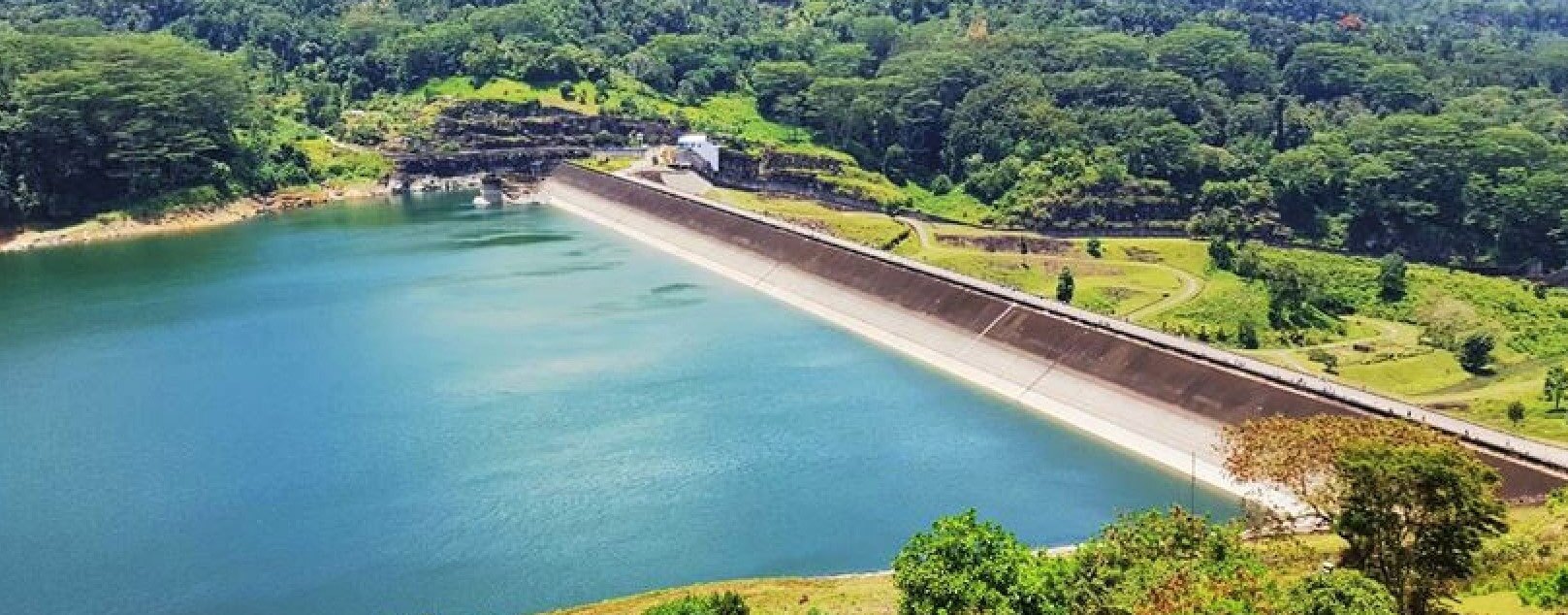
Kothmale
Reservoir/Dam
The Kotmale project is one of five major headworks projects
being undertaken under the Accelerated Mahaweli Ganga scheme. it is
the most upstream of these projects and develops the hydro potential
of a major right bank tributary of the Mahaweli Ganga, the Kotmale
Oya.
The Kotmale
Oya flows through the rural up-country of Sri Lanka passing ancient
villages steeped in history and tea plantations of a more recent
ara. The tranquility of this river valley has been changed recently
with the construction work of the Kotmale Hydropower reservoir.
Financial assistance for the project has been provided by the
government of Sweden
The Kotmale
Hydro-electric project
The Kotmale
project was one of the first projects taken up under the Accelerated
programme for development of the Mahaweli ganga. The basic elements
of the project are a dam on the Kotmale Oya ( a tributary of the
Mahaweli ganga) and a tunnel system leading to a power station with
the outfall of the mahaweli ganga. The primary function of the
project is the generation of electric power. Additional benefits
will arise from an increase in the amount of irrigation water
available at Polgolla due to regulation of flows in the Kotmale Oya.
Consultancy
services :
Preliminary
studies of the Kotmale project were carried out by the Government of
Sri Lanka with the assistance of US Agency for International
Development (USAID) in 1961 and subsequently by UNDP-FAO from 1964
to 1968. a feasibnility study of the project was carried out by the
water and Power Development Consultancy Services (India) Limited
(WAPCOS) from 1973 to 1976.
Sir William
Halcrow and Partners in association with Messrs Kennedy & Donkin and
the Central Engineering Consultancy Bureau (CECB) were appointed in
1979 fto provide consultancy services
Construction work commenced in February 1979. The reservoir was
impounded in November 1984 and commercial power generation commenced
in June 1985. The project was ceremonially commissioned in August
1985.
Scope
The Kotmale
project envisages the construction of a 87 m (285 ft.) high Rockfill
dam with a concrete membrane across the Kotmale Oya, an important
right bank tributary in the upper reaches of the Mahaweli ganga
about 25 miles upstream of the Polgolla barrage constructed under
Project I of the Master Plan.
The Kotmale
project was mainly for the development of hydro power and the
regulated discharge from the reservoir to increase the flow diverted
at the Polgolla barrage into the proposed Moragahakanda reservoir
for augmenting the irrigation suppled in systems. The reservoir
would reduce flood peaks and their frequency, thus alleviated the
floods in the Gampola area below it.
The dam would
create a reservoir having an effective storage capacity of about 174
m. cm. (141,000 acre feet) enabling regulation of a large proportion
of the recorded mean annual flow of the Kotamale oya at the dam
site. The water impounded by the reservoir would be conveyed through
an underground water conductor system to an underground power
station located at about 7.2 km. (4.5 miles) from the dam for
generation of electric power. After power generation, this water
will be discharged through the outfall into the mahaweli ganga at
the Atabaghe Oya confluence.
In addition to
the generation of power, the regulated waterwill improve the pattern
of inflows of the Mahweli ganga at the existing Polgolla diversion
dam. This will firm up the power benefits from Ukuwela power station
and serve to increase the irrigation water supplies from the
Bowatenne dam.
Location and
Access
The dam site
is at Kadadora located about 6.6 km (4.1 mls) upstream of the
confluence of Kotmale Oya with Mahaweli ganga at a place where the
river enters a narrow and deep valley with steep banks. It is close
to the Pussellawa-Ulapane highway and is 12 miles from Gampola town
and 88 miles from Colombo. The nearest railhead is Ulapone, 7 miles
away.
The power
house is underground and situated in the belly of the Atabage
Mountains, about 6.4 km (4 mls) downstream of the Kotmale Oya –
Mahaweli ganga confluence. the project headworks lie on the right
bank of the mahaweli ganga and is partly in the Kandy district and
partly in the Nuwara Eliya district. Access to the main project
headworks can be thourgh two routes. One is from the new access road
constructed from the Gampola – Nuwara Eliya road just outside
Gampola town, which passes close to the underground power station
and joins the Ulapane- Pussellawa road. The other is though the
latter road from Ulapane which passes close by the right abutment of
the dam.
The Kotmale
Oya has its beginning in the South Central massif at an elevation of
2134 m.(7000 ft.) and is about 70 km. (43.3 mls) in lengh draining a
toatal area of 58,534 ha.(226 sq.mls) and dropping 1,585 m (5,200
ft) before meeting the Mahaweli ganga. Rainfall data from 1907
onwards are available for this region.
Main features
:
- A rockfill
dam 87.0 m high and 600 m long
- A chute spillway with a capacity of 5500m3/Sec. consisting of 3
radial gates 14x15m
- A hourse shoe shaped 6.4, diameter low pressure tunnel system
nearly 7.0 Km. long with a capacity of 113.3m3/Sec (4000 cusecs)
- A high pressure shaft with diameter varying from 4.8 – 5.5 m
- An underground power station with an installed capacity of 3x67
MW.
- An access tunnel providing access to the power station and a
tail-race tunnel to discharge the water after generation of power.
Historical
Background
In the history
of country, Kotmale enjoys a very special place. This is due for no
other reason than the fact that King Dutugemunu, who is acknowledged
as our greatest King, spent his youth in the mountains and valleys
of Kotmale. This history, the story of Dutugamunu is familiar to us
all. The stream he bathed in is here; the village he lived in is
here; the field he tilled is here. The story of his life at Kotmale
is part of the folklore, idiom and life of this valley and its
people.
From that
historic epoch in which Dutugemunu lived, his name and message
beckons to all generations that follow. Many are the lessons that we
can learn and should learn from his life, his work, his vision and
his leadership. In my view, the most important of these lessons is
the need for thought and action in keeping with the demands of our
time.
Inherited
Lands :
More than
3,000 families who lived in the Kotmale valley had to lose their
homes and lands, some of them inherited through a continuity of
nearly twenty centuries. They were given alternate land on higher
elevations of Kotmale itself or in Kalawewa, Maduru-oya, and
Ulhitiya, which are being developed under the Accelerated Mahaweli
programme.
Geology:
The Kotmale
area has had a history of earthslips, landslips, and other
geological disturbances. Owing to this great care had to be taken in
the design of the various features of the project. Soon after
construction work was awarded and during the early stages of the dam
construction, when excavations of the riverbed were in progress, the
presence of a limestone layer underneath the bed rock below the dam
and extending up to the reservoir, was discovered. These and other
adverse features led to a through investigation of all the
geological features in order to see whether there are practical
problems liked landslides above the reservoir leakage of water
through the dam foundation into adjoining valleys, earth tremors,
etc. which could seriously affect the stability of the project.
Mahaweli Maha
Seya :
During times
of prosperity in ancient times, great cultural monuments and
outstanding structures were built. Similarly in keeping with ancient
tradition, a large stupa to be named as Mahaweli maha seya is
proposed at Kotmale, to depict the progress and development of the
country under the Accelerated Mahaweli Programme. This stupa is to
also compensate for the eight Buddhist temples which were inundated
and to also stand as a tribute to those who sacrificed their
ancestral land, which had been cultivated for generations in the
Kotmale Valley.
The Seya is
built on the right bank hill above the dam site at an elevation of
950 m (4150 ft.) above MSL ie. It overlooks the dam site from a
place 257m (845 ft.) above. It consists of a 200 ft. (61,0 m)
diameter and 11” thick reinforced concrete shell, which supports a
asquare chamber (31 ft.) a Dewatha Kotuwa (12 ft), a pinnacle 44(ft)
and a Kothderella (52 ft) respectively. The overall height of the
structure is 274 ft. (83.)
The Main
Physical Components of the Project
Basic Features
The catchment
area of the river at the dam site is 544 sq.kms mostly developed
under tea plantations. There were submerged by the reservoir was
mostly developed land. The dam is a thick earth core rock fill
structure.
The long term
mean annual runoff at the dam site is 2,430 thousand acre feet of
which 1.100 thousand ac.ft is presently being diverted at Polgolla.
Salient
Features :
Catchment area -
544 Km2
Mean river flow - 105 m3/s
Highest recorded river flow 761.5 m3/sec
Gross storage capacity (at 703m) - 174 million m3
Useful storage capacity - 154 million m3
Surface water area - 1374 Ha
Main Dam
Dam Crest
Length - 600 m
Dam Height (above foundation) - 87 m (max.)
Crest Elevation - 706.5 metres MSL
Total
Volume of rockfill - 4.3 x 10^6 m3
Tunnel
Length - 6954 metres
Diameter of tunnel
(inside concrete lining - 6.2 metres
Height of surge chamber - 142 meters
Penstock
Steel circular
5.55-4.80m diameter, 480m length, with surge tank
Tailrace
Length: 635 m; Maximum Level: 479 m above MSL : 476 m above MSL
Turbines (KAMEWA)
Type -
vertical Francis
Design (net head) - 201.5 meters
Speed of rotation -
375 revs/mm
Output: 67MW @
201.5 m effective head (rated) , 68 MW @ 231 m effective head
(Maximum)
Rated discharge : 35 m3/sec
Generators (ASEA)
Conventional
vertical
Type - Semi umbrella
9000 kvA, 0.85 pf, 3765 A
Generating voltage - 13.8 kv
50 Hz, 16
poles, 375 rev/min
Energy production capability - 310 GWH/ year (firm)
Energy production capability - 445 GWH/ year (initial) |