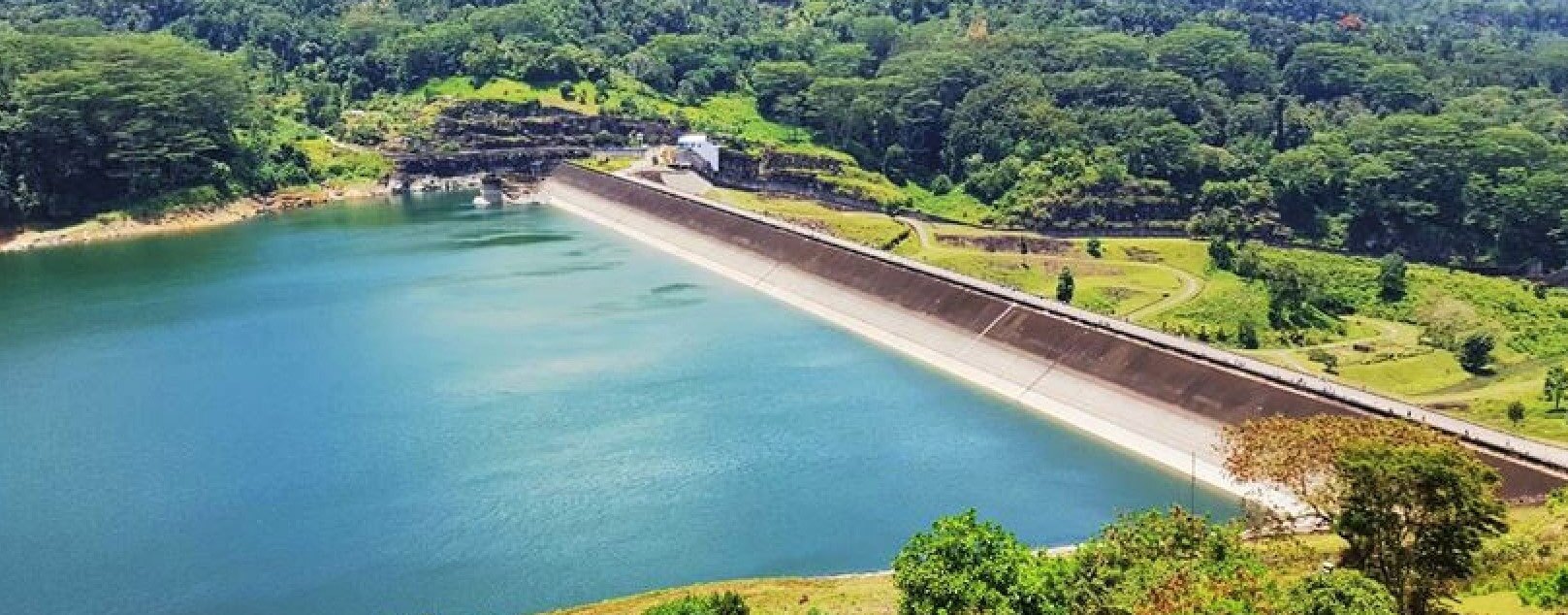
Bowatenna reservoir /dam
The Bowatenna
complex consists of a high diversion dam on the Amban Ganga at
Bowatenna,. a 4-mile-long diversion tunnel on the left bank followed
by about a mile long lined canal up to Dambulla Oya, a bifurcation
structure at Dambulla Oya to release part of the flows to the
Dambulla Oya which discharges into the Kalàwewa tank and the
remaining part into a short earthen canal which will feed the
Kandalama tank. (A reservoir with a net capacity of 7,500 ac. ft.
will be constructed across Dambulla Oya under Stage 11).
The diversion dam
would be a concrete structure. 741 feet long at the crest and 100
feet high with six radial gates and an earth embankment on the left
bank having a spillway of length 222’ and a 16 feet wide roadway on
the crest. The spillway would have a capacity of 125,000 cusecs
which corresponds to a flood of 100 year frequency. The maximum
operating pool level of the dam would be at elevation 820 feet and
the minimum at 800 feet which would provide an active storage of
21,000 ac. ft. The geology of the site is favourable. Rock outcrops
are exposed which are fractured and joined, consisting of gneisses
and quartzite’s. Boreholes data along the dam axis shows some
fracturing at depths, indicating the need for grouting.
The diversion tunnel
was 22,468 feet long with an unlined horse-shoe section 13 feet in
diameter capable of discharging 1,500 cusecs; about 30% of this
tunnel will be protected by concrete lining and shotcreting. Six
boreholes have been drilled along the 5 mile length of the
tunnel. In the upper part of the tunnel, the rock formations consist
of gneisses and quartzite which are fractured and joited. In the
lower half of the tunnel the rock consists of calc gneisses and
crystalline limestone. The groundwater table lies closer to the
ground surface in the lower half of the tunnel alignment and may
give rise to difficult problems of care of water during
construction. Geologists from USOM, FAO and UNDP mentioned in Para
5 above, inspected the site and endorsed the feasibility of
the tunnel. For supplying adequate information to contractors on the
geology of the tunnel, additional drill holes were made along the
axis.
The tunnel would
lead to an open-cut with depth of cut varying from 65 to 15 feet in
a length of 4,160 feet to Dambulu Oya. The canal would have a
capacity of 1,500 cusecs and would be lined with concrete. At
Dambulu Oya there would be a bifurcation structure for diverting
750 cusecs into the Dambulu7 Oya which feeds the Kalawewa tank
while the remaining discharge of 250 cusecs would be conveyed
through a short unlined canal, the Kandalama tank. Another
bifurcation structure constructed at the end of this canal will
divert 100 cusecs of the flow to 1-Iuruluwewa along a 16 mile canal
which leads to Habaraua Oya for feeding Huruluwewa.
Sudu Ganga Training Works
Water released from
the Polgolla tunnel and hydro-electric plant would be conveyed to
Bowatenna through the natural channels of Dhun Oya, Sudu Ganga and
Amban Ganga rivers. The additional flow of up to 2,500 cusecs in
these channels would affect their natural regime, particularly in
the Dhun Oya and the upper reaches of the Sudu Ganga, where the
existing capacity of the channels is less than 2,500 cusecs. Channel
improvements and training works would be required to prevent erosion
and damage to existing improvements. Inspection of the channels has
also indicated that parts of the cultivated land along the banks of
the Sudu Ganga, which would be subjected to flooding, may have to be
acquired and 3 road bridges, on the Sudu Ganga would have to be
remodelled to improve their Waterways. Some drop structures may
have to be constructed to stabilize the channel.
Elahera-Minneri-Kantalai-Yoda Ela Canal
The
Elahera-Minneri-Kantalai-Yoda Ela canal (referred to as the Elahera
canal) is an old canal which has been restored and remodelled
several times in the past two decades. It takes -off from the
Elahera weir on the Amban Ganga and runs along a contour to the
Minneriya tank with a by-pass feeder to the Giritale tank. It takes
off again from the Minneriya tank, passes above the Kaudulla tank,
augmenting the supplies to the latter through a special feeder and
then spills into the Yoda Ela canal which discharges into the
existing Kantalai tank. The total length of the canal from the
Elahera weir to Kantalai tank is about 38 miles consisting of 22
miles from Elahera to Minneriya and 16 miles from Minneriya to
Kantalai. Its present capacity is 1,000 cusecs in the’ first 4.9
miles, 1,250 cusecs from 4.9 to 6.3 miles and 1,500 cusecs ifl the
remaining 15.7 miles to the Minneriya tank. From the Minneriya tank,
the canal has a single bank on the right side and intercepts all the
drainage from the left bank. Here it is in effect, a catch-water
drain with large pools at places where the natural streams enter the
canal. In view of its high right bank, it can carry over 2,500
cusecs of peak floods.
The entire canal from Elahera weir to Kantalai is poorly
maintained. Below Minneriya tank, there is a heavy growth of weeds
and bushes which restrict the waterway and cause heavy water losses.
In order to meet the full irrigation requirements of areas Dl
and G, and also to fill the tanks in time for regulation and
storage, the capacity of the Elahera canal would be increased to
1,600 cusecs up to the Minneriya tank. Beyond this point, no
increase in the theoretical capacity is required, but considerable
work has to be done to restore the waterway by clearing the weeds
and bushes and widening the restricted sections. After the canal is
fully remodelled, it would require heavy annual maintenance to
maintain its capacity as the numerous natural streams entering the
canal throughout its length would cause silting, encourage weed
growth and create large standing pools. The alternative is to
construct a regular canal with two banks, crossing all the natural
drainage lines by siphons underneath the canal. This would require
146 drainage siphons to cross the 146 natural streams draining a
catchment’s of 40 square miles on’ the left bank from Elahera to
Minneriya and another 65 drainage siphons to cross the 65 natural
streams draining a catchment’s area of 17 square miles on the left
bank from Minneriya to Kantalai. The main advantages of this
alternative would be the reduction of water losses and annual
maintenance costs. However, the main disadvantages are the heavy
capital cost of construction, the hazards of damage to the numerous
cross drainage works during heavy rains, which would increase the
annual maintenance cost and might also make the canal inoperative at
times and, above all, the waste of an important source of water from
the left bank catchments of the canal varying from 60,000 to 20,000
ac. ft. annually, which can be regulated in the tanks and utilized
for irrigation.
The Elahera weir
would be remodelled to raise its pond level by an additional 2 feet
and a new head regulator would be constructed on the left bank,
adjacent to the existing regulator, with a capacity of 700 cusecs to
provide additional supplies to the Elahera canal. The first 1,000
feet of Elahera canal runs through a deep cut in rock and is lined
with concrete. It would be widened and re-modelled to increase its
capacity to 1,500 cusecs.
|